
Why European Companies Face Rising Payment Risks in 2026
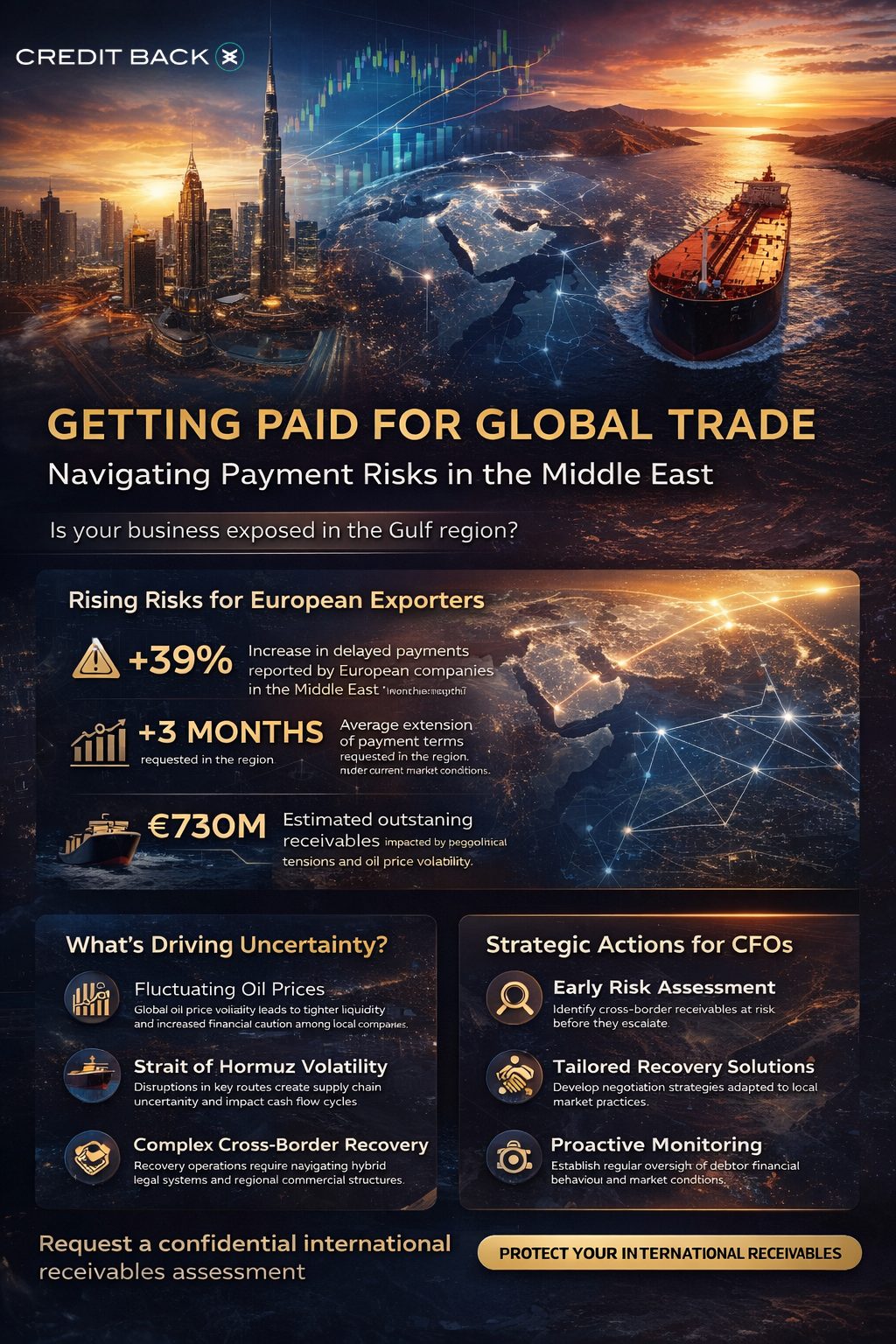
For many European exporters, the Middle East represents opportunity.
- Strong demand.
- Large infrastructure projects.
- Ambitious investment strategies.
- Fast-moving commercial environments.
On paper, markets such as the UAE, Saudi Arabia or Qatar appear financially solid and commercially attractive.
Yet behind this growth narrative, a quieter reality is emerging.
Across multiple sectors, European companies are experiencing longer payment cycles, renegotiated obligations and increasingly complex recovery situations.
At CREDIT BACK, we are seeing a clear increase in international cases where profitable trade relationships are gradually turning into financial exposure.
In most situations, the issue is not the original transaction.
It is the environment in which payment must ultimately be enforced.
When Energy Markets Become Payment Risks
The recent escalation of tensions involving Iran has contributed to renewed volatility in global energy markets.
Fluctuations in oil prices, combined with uncertainty around key logistical routes such as the Strait of Hormuz, are already influencing financial behaviour across the Middle East.
In economies where energy costs play a central role in corporate liquidity cycles, these dynamics often translate into more cautious cash management strategies.
Companies may prioritise operational resilience, renegotiate payment timelines or temporarily delay settlements with international suppliers.
For European exporters, the impact is rarely immediate — but it is often progressive.
What begins as a short delay can evolve into extended payment negotiations, contractual disputes or complex cross-border recovery scenarios.
Dubai, as a regional financial hub closely linked to energy-driven economies, inevitably reflects these pressures.
Even businesses with historically strong payment records may face internal liquidity adjustments as market uncertainty increases.
In this context, receivables that once appeared low-risk can become significantly more exposed.
Understanding the broader financial environment is therefore essential when assessing payment risk in the region.
Geopolitical developments do not automatically lead to default — but they frequently alter the financial dynamics that determine how and when international obligations are honoured.
The Costly Misconception: “Dubai Works Like Europe”
One of the most common assumptions among European companies is that contractual enforceability in the Gulf mirrors European standards.
In practice, cross-border debt recovery in the Middle East often involves:
• multi-layered corporate structures
• regional holding entities with limited operational assets
• negotiation dynamics influenced by local commercial culture
• hybrid legal frameworks combining civil law, common law and local regulation
• reputational and relationship-driven settlement strategies
Waiting too long to act is frequently the most expensive decision.
By the time professional recovery support is considered, informal negotiations may have already weakened the creditor’s position.
At that stage, recovery strategies become slower, more complex and more costly.
International Recovery Requires Execution — Not Just Legal Advice
Debt recovery in high-risk regions is not purely a legal process.
It is a financial strategy requiring coordinated execution across jurisdictions.
Effective recovery often depends on:
• timing of intervention
• negotiation leverage
• understanding of local market practices
• structured escalation planning
• access to specialised regional networks
At CREDIT BACK, our focus is on practical recovery outcomes rather than theoretical legal positioning.
In many international cases, early intervention enables structured solutions that avoid lengthy litigation while maximising financial recovery.
In complex cross-border environments, execution capability is often the decisive factor.
Growth in the Gulf Means Greater Financial Exposure
Trade flows between Europe and the Middle East continue to expand significantly.
This growth creates commercial opportunities — but also increases financial risk exposure.
Companies entering new markets frequently prioritise revenue expansion over payment risk control.
When payment behaviour deteriorates, internal teams may lack the expertise, network or strategic tools required to respond effectively.
The consequences are predictable:
• increasing provisions
• cash flow pressure
• internal financial stress
• complex reporting implications
In some cases, receivables ultimately become non-recoverable despite initially strong commercial relationships.
The Recovery Window Is Shorter Than Most Companies Expect
In international debt scenarios, time has a measurable financial impact.
The longer a receivable remains unmanaged, the higher the probability of:
• asset dilution
• restructuring of debtor entities
• deterioration of negotiation leverage
• jurisdictional enforcement barriers
Early intervention does not guarantee recovery.
However, delayed action significantly reduces the probability of a successful outcome.
This is particularly relevant in regions where legal execution can be time-intensive and commercially sensitive.
A Strategic Approach to Protecting International Receivables
Companies operating in the Middle East increasingly recognise the need for specialised recovery strategies adapted to regional realities.
At CREDIT BACK, we support European businesses in analysing, structuring and executing international recovery actions designed to maximise financial outcomes while preserving commercial relationships whenever possible.
Each case requires a tailored approach based on jurisdiction, debtor profile, sector dynamics and timing.
In cross-border recovery, strategic execution often determines whether a receivable becomes a recovered asset or a financial write-off.
Is Your Business Exposed in the Gulf Region?
If your company has outstanding receivables in Dubai or across the Middle East, early strategic assessment can significantly influence recovery prospects.
Understanding the financial and operational context of the debtor is the first step in protecting your balance sheet.
CREDIT BACK provides confidential international portfolio assessments and tailored recovery strategies for complex cross-border environments.
• No upfront cost evaluation
• International recovery expertise
• Tailored strategic approach
In international debt recovery, time is rarely neutral.
Acting before financial deterioration accelerates is often the most effective decision a company can make.
Frequently Asked Questions – Debt Recovery in the Middle East
Debt recovery in the Middle East often involves additional layers of complexity, including multi-jurisdictional corporate structures, different legal frameworks and region-specific negotiation dynamics.
Early strategic intervention is therefore essential to maximise recovery prospects.
Rising geopolitical uncertainty can influence corporate liquidity cycles, particularly in energy-driven economies.
Increased oil price volatility and financial caution may lead to extended payment timelines, renegotiations or delayed settlements.
Companies should seek specialised support as soon as payment delays begin to extend beyond agreed contractual terms.
Early intervention significantly improves recovery probability in cross-border environments.
In many cases, structured negotiation strategies and coordinated international recovery approaches can lead to successful outcomes without the need for lengthy litigation.
The feasibility depends on jurisdiction, debtor profile and timing.
Businesses operating in sectors such as construction, logistics, energy, commodities, industrial supply and international trading are typically more exposed due to the scale and complexity of regional commercial structures.
Not necessarily.
Cross-border enforcement may still require strategic legal and commercial coordination within local jurisdictions, depending on the structure of the debtor entity and the assets involved.
Recovery timelines vary significantly based on the complexity of the case, debtor cooperation and jurisdictional factors.
However, delays in initiating recovery actions almost always extend the overall process.
Proactive counterparty assessment, structured payment terms, ongoing monitoring of financial behaviour and early response to delays are key risk-management practices.
Yes.
International cases often require coordinated strategies involving local expertise, structured negotiation and jurisdiction-specific execution capabilities.
An early strategic portfolio assessment helps identify recovery options, potential risks and the most effective intervention strategy before the situation deteriorates.
Protect Your International Receivables Before the Situation Escalates
If your company is experiencing delayed payments or growing financial exposure in Dubai or across the Middle East, early strategic action can significantly influence recovery outcomes.
International debt recovery is highly time-sensitive.
The longer a situation remains unmanaged, the more complex and costly recovery may become.
At CREDIT BACK, we provide specialised international receivables assessment and tailored recovery strategies designed for complex cross-border environments.
What you can expect:
• Confidential portfolio review
• No upfront cost evaluation
• Strategic recovery approach adapted to the region
• International negotiation and execution expertise
Understanding your exposure today can prevent financial loss tomorrow.